
This winter, while many are fixated on crude oil, coal, copper, and gold, few notice a more 'undercover' commodity: PVC (polyvinyl chloride).
Its importance is beyond imagination: the world's second-largest general-purpose plastic, second only to PE; closely related to real estate and infrastructure, it is a crucial chemical material for construction and urbanization; China accounts for more than half of global production capacity and is the absolute pricing power; the industrial chain affects millions of industrial workers. However, this very important industry has experienced a brutal plunge over the past three years. Prices hit a decade-low, the entire industry was in the red, the gross margin once fell to-17%, and inventories approached a historic peak, exceeding 1.38 million tons.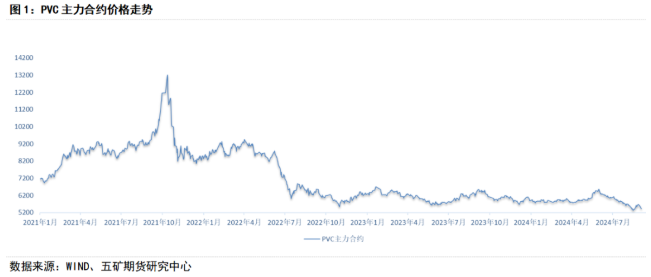
When an industry's cash flow can no longer cover its operational costs, it typically ceases its downward spiral. But the critical questions remain: Will it reverse? Will it rebound? Or will it remain in a prolonged sideways consolidation phase? This article will demystify the cyclical logic of PVC through rigorous data analysis and logical reasoning.
1. China remains the global leader in PVC:
Capacity continues to expand, pattern is finalized
1.1 What is PVC and why is it important?
Polyvinyl chloride (PVC), a polymer derived from vinyl chloride monomer (VCM), plays a pivotal role across diverse consumer sectors. Approximately 60% of its demand is directly tied to real estate applications, including profiles, doors/windows, flooring, and piping systems. Another 20-30% serves infrastructure needs, such as drainage pipes, power cables, and protective sleeves. The remaining portion finds extensive use in healthcare, chemical, and industrial manufacturing. In essence, PVC has become a cornerstone chemical material that drives construction industry growth and urbanization.
1.2 Over the past five years, China's production capacity has continued to expand
According to industry data, China's PVC production capacity and output have been growing steadily, reaching 26.07 million tons in 2020 with an output of 21 million tons. By 2024, production capacity is expected to further increase to 29.11 million tons, with an output of approximately 23 million tons. The core drivers of this growth include reduced production costs due to declining energy prices, expansion by leading enterprises amid increased industry chain concentration, support from the mature "coal→calcium carbide→PVC" industrial system, and accelerated production expansion in China's PVC industry following the global pandemic from 2020 to 2021, which strained overseas supplies.
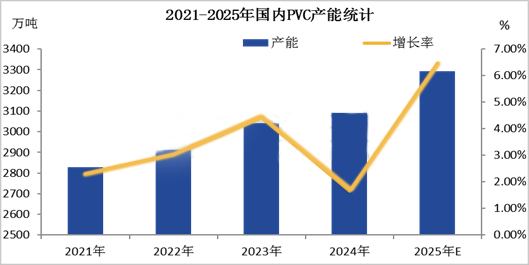
Currently, China's PVC production capacity accounts for over 50% of the global total, having transformed from a "global participant" to a "global pricing power". The industry now exhibits a typical "strong supply, weak demand" pattern—lower prices lead to increased production capacity, while weaker demand results in higher inventories.
2. Demand-side slowdown:
The real estate market is declining, and the demand for PVC is not strong
2.1 Real estate is the core downstream of PVC
PVC demand is extremely sensitive to the macroeconomy, often referred to as the "real estate mirror in chemical products." Over the past three years, China's real estate sector has entered a period of deep adjustment, with new construction area experiencing negative growth for three consecutive years. The completion volume began to decline again by the end of 2024, and the sluggish housing sales and falling investment have directly hit PVC demand hard.
2.2 Data: Demand Plummets
In 2022, PVC apparent consumption dropped 16.86% year-on-year to 20.05 million tons. From 2023 to 2024, demand showed only a slight recovery, with 2024 consumption reaching approximately 20.8881 million tons—a mere 1.31% increase. This modest recovery proved insufficient to absorb the massive production capacity generated by the industry's sustained expansion.
3. Inventory pressure has reached a critical level:
Prices fell to the point where the entire industry was losing money
3.1 High Inventory Becomes the "New Normal" of the Industry
Since 2023, PVC inventories have been on a steady rise. By early 2025, they stood at approximately 1.2 million tons, and after the Spring Festival stockpile (in March), the figure surged to 1.3886 million tons, nearing record highs. This high inventory level directly reflects the industry's supply glut and weak demand, exerting sustained pressure on PVC prices.
3.2 Price falls below the industry profit bottom line
As of March 2025, the average PVC price stood at 4,775 yuan per ton, down 10.53% from 2024. With a gross profit of-858 yuan per ton and a gross margin plunging to-17.54%, the data indicates that PVC production has plunged into industry-wide losses. Similarly, overseas ethylene-based plants have also fallen below their cash flow cost line.
This highlights a key distinction: PVC avoids the 'crude oil-style' negative pricing. With its stable physical properties, long-term storage capability, low storage costs, and export-driven absorption, PVC is less prone to price collapse caused by storage pressure. This significantly reduces the risk of market panic.
IV. Industry Trends:
Green Transformation Accelerates, Ethylene Method Ratio Rises, Concentration Improves
4.1 Two Processes: Calcium Carbide Process VS Ethylene Process
More than 70% of China's PVC production capacity uses the calcium carbide method, due to low electricity costs and abundant coal resources. However, with the advancement of the "dual carbon" policy (energy consumption restrictions, mercury pollution control, environmental taxes, and carbon trading pressures), the proportion of the ethylene method is expected to gradually increase.
Comparison Dimensions | Calcium Carbide Method | Ethylene Method |
Raw Material & Technology | Coal, limestone, calcium carbide | Crude oil, ethylene |
Merits | Low cost, simple installation | Low pollution, high product quality |
Shortcomings | High mercury pollution, high energy consumption | Cost affected by oil price fluctuations, large device investment |
4.2 The Concentration Degree Increased Significantly: Small and Medium-sized Enterprises Gradually Withdraw
In 2024, over 20 billion yuan was invested in environmental technology upgrades across industries, dealing a devastating blow to small and medium-sized enterprises (SMEs). Leading companies, leveraging their financial, technological, and scale advantages, are expanding their market presence, creating an industry landscape where "the big get bigger while SMEs get phased out." Notable industry leaders include Junzheng Group (2023 revenue: 18.39 billion yuan), Xinjiang Tianye, Beiyuan Group, Chlor-Alkali Chemical, and Huasu Shares.
5. Why has PVC prices plummeted so sharply?
Triple negative resonance
5.1 The first big negative: Energy costs collapse, cost line moves down
PVC is fundamentally an energy-intensive material. Calcium carbide is derived from coal, ethylene from petroleum, and electricity accounts for 40-60% of production costs. Over the past three years, declining coal prices, falling international oil prices, and oversupply of thermal coal have caused a systemic cost reduction across the entire industrial chain, ultimately dragging down prices.
5.2 The second major negative: The real estate infrastructure downturn, demand sharply reduced
As previously noted, approximately 60% of demand is directly tied to the real estate sector. The industry's profound restructuring has virtually eliminated growth potential for PVC demand.
5.3 The third negative: The "false prosperity" in 2021 led to massive expansion of production
The global liquidity expansion from 2020 to 2021, combined with the extreme cold weather in the United States leading to production halts at overseas facilities, caused global supply shortages. China's PVC exports surged by 347% at one point, with prices hitting record highs. The industry misjudged this as the "beginning of a new cycle," triggering large-scale production expansion and laying the groundwork for today's overcapacity.
Bottom line: Cost collapse, demand cliff, and overproduction create a triple whammy of bearish factors, pushing the industry into a trough.
6. PE and PVC:
Similar but Different: Periodic Resonance of "Brother Species"
PVC and PE (polyethylene) are both bulk plastics. Their production costs are influenced by energy prices, while demand is tied to consumption and real estate markets, resulting in highly synchronized price movements. However, there are key differences:
Comparison Dimensions | PVC (Polyvinyl Chloride) | PE (Polyethylene) |
Material Quality | Hard | Soft |
Main Applications | Doors and windows, profiles, pipes (mainly used in real estate and infrastructure) | Bags, film, packaging (mainly used in consumer goods) |
Prime Cost Dependence | More partial to coal (relying on the "coal-calcium carbide-PVC" industrial system) | More dependent on crude oil (derived from crude oil-based ethylene) |
Key Raw Materials | Coal, limestone, calcium carbide | Crude oil, ethylene |
In 2021, PVC prices surged far more than PE, primarily due to a supply gap caused by multiple overlapping factors: extreme cold weather in the United States led to large-scale shutdowns of PVC plants, while China's calcium carbide production was impacted by the "dual control of energy consumption" policy, resulting in supply contraction. Coupled with strong overseas demand driving a surge in China's PVC exports, this supply gap under dual pressures ultimately led to PVC's independent and dramatic price rally.
7. The bottom has appeared.
But be extremely careful when buying at the bottom
7.1 The price has already approached the lowest cash flow cost in the world.
Industry estimates indicate that the minimum full cost for integrated calcium carbide-based PVC in Inner Mongolia ranges between 4,160–4,600 yuan per ton. With current prices at 4,400–4,500 yuan per ton, they have breached this cost threshold, plunging the entire industry into losses. This confirms that the PVC price floor is firmly established at 4,500±200 yuan per ton, with limited room for further decline.
7.2 But bottom = reversal
The current PVC market is ill-advised for bottom-fishing, with three key reasons: demand remains severely sluggish, as declining real estate completion and new construction data continue to suppress demand; inventories remain stubbornly high at 1.38 million tons, with significant headwinds hindering inventory reduction and further market recovery; meanwhile, futures premiums have already priced in future expectations. For instance, the current premium of around 500 yuan for the main 2609 contract has substantially weakened the odds for right-side trading. Given these converging factors, bottom-fishing requires cautious consideration.
7.3 How to participate? Left vs. right side strategy choice
The left-side strategy (cost-based support) identifies the 4600–4800 yuan/ton range as a bottom zone, recommending a phased pyramid-style position-building approach with strict position control to mitigate time costs. The right-side strategy (event-driven waiting) requires patience for three potential reversal triggers: significant improvement in real estate policies (currently low probability), large-scale contraction in overseas supply (e.g., equipment maintenance), or strong macro-level easing policies to stimulate demand recovery. As none of these critical signals have materialized yet, the right-side entry timing remains immature.
8. Future Outlook:
Will PVC move left or right?
8.1 Supply side: End of expansion cycle
Forecasts indicate that after 2025, the PVC market will see virtually no large-scale new capacity additions. The impact of individual planned projects on the industry's supply-demand balance remains limited. This signals the official conclusion of the 2019-2024 expansion wave, with the most significant supply-side headwinds that previously suppressed the market now being gradually exhausted.
8.2 Demand side: The key is macro
While the real estate sector remains sluggish, demand-side indicators have shown modest positive shifts. These include the government's sustained efforts in affordable housing development, steady progress in urban renewal initiatives, resilient municipal infrastructure, and signs of overseas demand recovery. However, whether these favorable factors will translate into a sustained demand rebound and ultimately improve the PVC market's supply-demand balance remains uncertain.
8.3 Conclusion: It is more likely to enter a low-level fluctuation rather than a rapid reversal
Historical pattern: Between 2015 and 2016, PVC prices hit historic lows before stabilizing for about a year, rebounding only after overseas supply contraction. The 2025 PVC market is likely to follow a similar trajectory: entering a phase of low-level consolidation, awaiting clear supply-demand catalysts, and ultimately achieving a sustained trend reversal.
9. Summary of the full text:
Standing at the Bottom, but Not a Reversal
Key takeaway: The price bottom for PVC is now clearly established, though the catalyst for a sustained price reversal remains underdeveloped. The optimal strategy is to establish positions on the downside while patiently awaiting a bullish signal to confirm the reversal.
Core logic:
1. Supply situation: China's production capacity is the largest in the world, and the expansion cycle has ended.
2. Demand drag: The real estate downturn has weakened core demand.
3. Inventory overhang: While the entire industry is in the red, high inventory levels are dampening price elasticity.
4. Cost bottoming: Prices have approached the global cash flow cost floor.
5. Structural changes: Environmental policies have driven industry consolidation, strengthening the dominance of industry leaders.
6. Limited risk: Physical properties mean there is no risk of negative price extremes.
7. Bottom range: The clearly defined cost floor is 4300–4500 yuan per ton.
8. Reversal conditions: require event-driven catalysts such as significant improvement in demand margins or unexpected supply-side contraction.
Implications for investors and industry professionals:
Short-term: The market will consolidate at a low level.
Medium term: Watch closely and wait for marginal improvement signals.
Long-term perspective: Industry consolidation will intensify, with leading enterprises' competitive advantages growing steadily.
PVC is not a sexy high-growth sector, but it serves as a classic sample for observing the supply and demand cycle of China. It reveals a major trend: all midstream raw materials strongly related to real estate are undergoing deep capacity and price clearance; only after the clearance is completed will the industry see a true revaluation of its value.
■Disclaimer: This article incorporates content from third-party websites primarily to share information, with no commercial intent. All views and descriptions in the reprinted material are the sole responsibility of the original source, and this platform assumes no liability. For copyright protection or infringement concerns, please contact us for removal. Copyright remains with the original author. The content is for reference only and does not represent the views of this platform or its affiliated institutions. Investors bear full risk of market entry. The futures market involves risks—invest with caution!

Add: Rm. 604, Building 3, No. 188, Aona RD., (Shanghai) Pilot Free Trade Zone,China
Phone: +86-021-50350029
Email: marketing01@newayphc.com


 ENGLISH
 简体中文
简体中文